The slideshow presented by the O.F.C.C. is available here.
If you want to know about O.F.C.C. you’ll have to ask Fraser, Ken, Marg or Shirley.
The slideshow presented by the O.F.C.C. is available here.
If you want to know about O.F.C.C. you’ll have to ask Fraser, Ken, Marg or Shirley.
This video may be a good primer for Depth of Field and may be a good one to show during the club meeting. It is 6:13 minutes in length.
Part 1- Short Lens by Mike Browne
https://www.youtube.com/watch?v=8uU9O8c7Hss
And here is the other part of Mike’s demonstration where he pulls it all together
Part 2- Long Lens by Mike Browne
https://www.youtube.com/watch?v=98-WvzWvt7M
This one is pretty basic and is fairly easy to understand
By Cam Crunch
https://www.youtube.com/watch?v=iHxG1f3X1f4
This one is a bit more technical and is explained with drawings. While a little harder to get your head around, it may help to shed light on the concepts in a different way.
By Dylan Bennett
https://www.youtube.com/watch?v=34jkJoN8qOI
Some good tips on shooting photographs that require a very wide depth of field.
By lynda.com
https://www.youtube.com/watch?v=XlQaiCPTFS4
(Hint: Also, search YouTube for “Hyperfocal Distance”)
Some good demonstrations on shooting portraits with a shallow DOF
By Adorama TV
https://www.youtube.com/watch?v=OUYuUs1aaCU
There are many Depth of Field Calculators available online and in Apple and Android environments. You can simply dial in your Camera Sensor Size, Aperture Value, Focal Length and Distance to Subject. The DOF calculator will give your DOF for those values.
Phil Tughan
 At the April 7th meeting Ron Pearce gave us an excellent presentation on how to enhance an image by creating a composite with textures. His images are available here.
Click here to see Anne Jones’ notes on iPhone Photography from the April 7th meeting.
Anne also mentioned PhotoSync for moving photos between her Apple devices.

You should try shooting all sorts of stuff – from food to landscapes, from portraits to sports, from products to travel, and everything in between. When you are just starting out, shoot everything. And once you have done that, sit down and figure out what kind of photographer you really want to be and work on that.
The first step is to take a good look at the stuff you’ve been shooting and ask yourself, “Which one of these do I seen to have knack for? Or, Which shots have people told me I have a knack for? Chances are there is something you shot that you particularly felt you had a knack for – you just kind of knew what to do.
Okay, that’s step one (and it might be more than one thing – you might feel like you have a knack for travel, sports and natural light portraits, and that’s okay). The next step is to ask yourself, “Which one of these do I really enjoy shooting?” This is really important, because this is what you should be focusing on. There’s no sense at getting really good at product photography when what you really want to be is a natural light portrait photographer.
But, few photographers, even more experienced ones, really sit down and think this through – they just shoot what comes their way. And while they may wind up being competent at shooting a lot of different things, I’m guessing being competent isn’t your goal (it’s like getting a C+ in class). Finding who you are as a photographer allows you to focus your learning, your energy, and your time in the right direction. When you start to get good at what you really enjoy, this is when the magic happens.
Marg Jackman
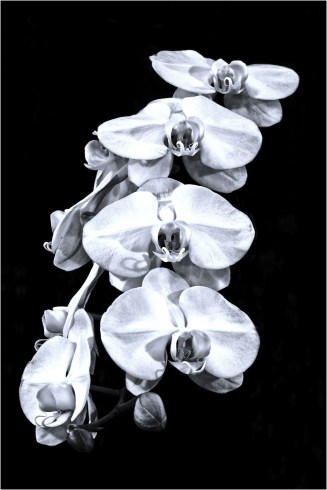
For a chance to shoot some spectacular flowers, visit the orchid show which is back at the RA Centre on the weekend of Saturday April 22 from 12:00 to 5:00 and Sunday April 23 from 9:00 to 5:00.
For more details check out their website. They encourage photography but limit the use of tripods to Sunday the 23rd from 9:00 to 11:00
To see a few examples of images shot by club members at a past show look at our May 2014 gallery.
The next Camera Club meeting with be held on Friday April 7th at 9:15 AM.
Our meeting will include:
Your images from the March “Fixed in Post” assignment include either:
Your images for the March assignment must be emailed by noon on Friday, March 31st to be included in the slide show. For details on how to submit photos including formats and titles (see above for title changes to the filename for this assignment) go to our Galleries page.
The Mentors will be available before the meeting to help you with any technical or creative questions you have about photography.
See you on April 7th.
 Did you know that Friday March 31st is World Backup Day?
If your computer or smartphone failed tomorrow or it was infected with ransomware, all the files it contains could be lost! Would you lose all your precious photographs?
Do you have a backup plan in place?
If you need help with setting up a backup procedure why not book an hour with one of the Seniors Council’s computer tutors? They can help you set up a safe, thorough and automatic backup procedure for all your files.

General Guidelines
It is hard for a photographer not to be sensitive to remarks about changes and possible improvements to ones’ photographs. Remember the comments are on the photographs not the photographer. Some of the comments will carry with them the bias of the reviewer. As an example a world class female reviewer once told me about this problem by saying: “I hate snakes, so it is real hard for me to give a good review on a snake, no matter how good and wonderful the photograph may be.”
Also there are no definite rules of what makes a bad or great photo which have come to us from Mount Sinai. Even generally accepted rules, such as the “Rule of Thirds” can be successfully broken. For those who do post processing remember there is never a photograph taken that cannot be improved in some way – including how it is framed. Now on with some basics of doing a critique.
Basic Critique Considerations
One of the best ways for a photographer to improve is by having their work critiqued. Even though one may not agree with critique points made, the process helps one identify what appeals to the viewers and what does not. With this understanding you are better able to create the best photograph you or a viewer likes. The more you practice and apply your knowledge the better photographer you will become.
Based on this post by Scott Bourne in the Photofocus blog.
Frank Knor
 Kanata Seniors' Centre Camera Club