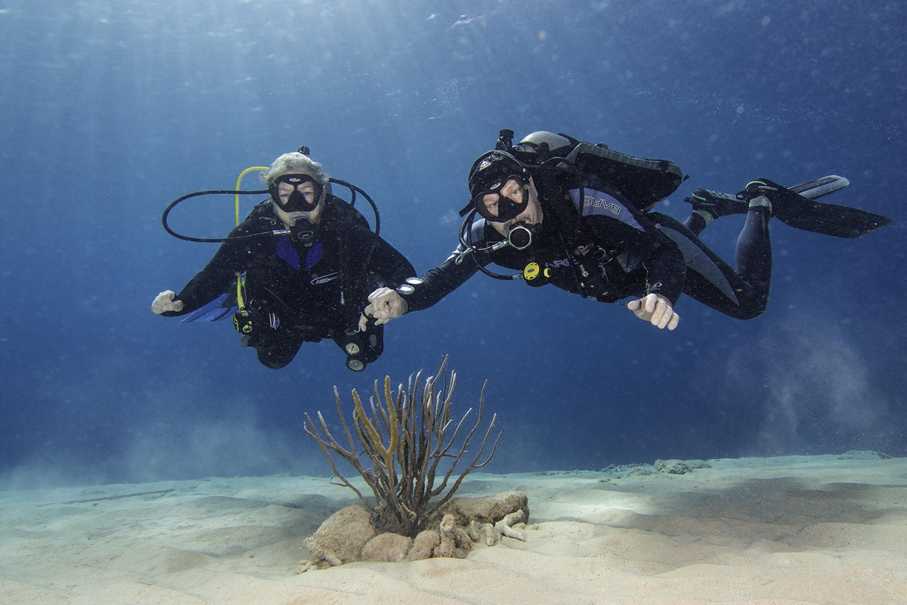
You can review Ted’s excellent presentation on underwater photography as a PowerPoint deck or as a pdf.
You can review Ted’s excellent presentation on underwater photography as a PowerPoint deck or as a pdf.

The photos in my slideshow are from a photography trip I took with my daughter to Morocco in May 2012. The focus was mostly on street photography. It was definitely a memorable experience, and looking at the pictures brings me right back to the places we visited.
It was through Strabo Tours, and the professional photographer was JJ Weiss (who has since passed on). His biography:
I had the greatest good fortune to begin photography as an apprentice to the legendary Minor White at M.I.T. That blessing was even more enhanced when I got my M.F.A., studying with Harry Callahan and Aaron Siskind, both master photographers, at the Rhode Island School of Design. Just six years after printing my first photo, I was appointed to a professorship in art at the University of Delaware, where I led the photo program for 30 years. Our graduate studies program was praised by The Photo Review for its “outstanding contribution to photography,” and I was also cited for an Excellence in Teaching award. In 2006, I received national recognition as Teacher of the Year by the Santa Fe Center for Photography. I’ve led 30 photo safaris and tours for Strabo.

The description of the tour
Morocco is a beautiful country filled with friendly people and irresistible allure. Most excitingly, photographs seem to beckon around every corner. There is so much to see. Marrakech is home to the famous outdoor market, Djemaa el Fna, perhaps the greatest open-air spectacle in the world. Among many delights, you will see snake charmers, dance troupes, and storytellers regaling fascinated listeners with tall tales. In Fes, the center of culture and religious learning, we will photograph in its ancient Medina. Kiosks abound all over, vendors selling their goods much as they did thousands of years ago. This year, we’ve added a new destination in the north, Chefchaouen. Pronounced, shef-shau-en, the town was founded in 1492 by Moorish exiles from Spain. Our accommodations are set in the hillside, just above the town, away from the hustle and bustle of the medina, yet within walking distance to the areas where we’ll be photographing. In the medina, the outdoor market vendors sell all sorts of vegetables and fruits amid the narrow cobbled alleyways of whitewashed walls and blue doors. It’s a photographer’s delight. And, of course, our visit to the Sahara is a particularly unique adventure. We arrive in mid-afternoon, photographing the dunes, the camels, and the herders. Then we are witnesses to one of the most amazing sunsets you will ever see. Following an al fresco dinner, and entertained by tribal musicians, we sleep, then rise before dawn, where Tuareg tribesmen help us to mount our camels, and ride up the dunes to photograph the magnificent Saharan sunrise.
Debbie Pinard

If you missed Javier Frutos’ excellent presentatio at our September 10th meeting or if you’d like to review it at your own pace, it is available here.
Ramin Izadpanah will be presenting Confessions of a Photographer at our May meeting. Prior to the meeting you may wish to view the following video by Ansel Adams, Master Photographer.
Although the video was made in 1983 it’s interesting to see how enthusiastic Adams was about the potential for digital photography.
Ottawa is blessed with a wide variety of habitats and natural and man-made environments. You can find wetlands, rivers, lakes, ponds, forests and farm land. This allows many species of wildlife to abound here.

In Manfred’s presentation he mentioned this paper on Evaluating the Rule of Thirds in Photographs and Paintings.
Sue Carey sent along this excerpt from Freeman Patterson’s newsletter:
I’d also like to draw your attention to www.earthisourwitness.com, produced by Parimal Deshpande and hosted by him and the internationally-renowned photographer, Art Wolfe, both from Seattle. This is a series of stimulating conversations with photographers from around the world, selected by Art and centred on some of their images. The series is a work-in-progress; you can view those already filmed and there are more to come. Don’t miss the compelling conversation with Wade Davis, the Canadian anthropologist and photographer, who was explorer-in-residence at National Geographic for several years. (My conversation on SYMBOLS and MEANING will be recorded March 2. View live on http://www.facebook.com/earthisourwitness, on http://www.instagram.com/earthisourwitness, and live or for up to a year on YouTube: https://www.youtube.com/c/EARTHISOURWITNESS.)

We are lucky to have photography as our hobby. During this difficult time we still can use our cameras to express ourselves by capturing images we see in our minds. Composition plays a big role in making our photos most appealing. This video gives a great summary of some major composition forms. May you enjoy it as I do. Be safe.
Frank Knor
On our daily walks in our neighbourhood , we find stones some residents painted and distributed along paths…

… to thank health care workers …
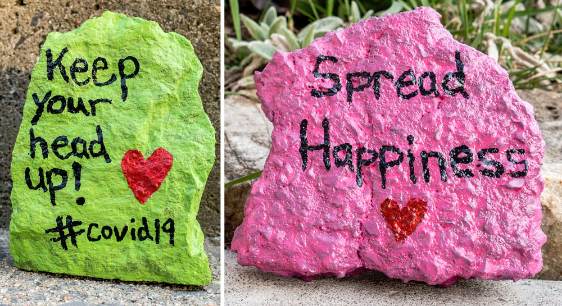
… to cheer you up …

… to make sure you do not feel alone …

… to make you feel strong …
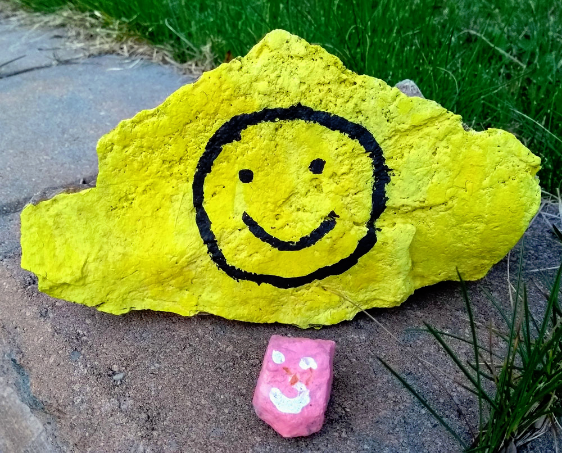
… to make you happy.
Peter von Moos
For the first time since opening in 1950, the famous Keukenhof flower garden, whose 7 million bulbs attract about 1.5 million visitors from all over world each year, is closed due to the Covid19 pandemic. Fortunately Albert Dros, a Dutch photographer was able to gain access to the garden and spent a day capturing these images of the beautiful flower fields, without people.
Amy Lo
While we’re all cooped up at home, we might want to try some macro photography.
Phil Tughan

