Marg’s Tip for November

Winter Photography Tips

No matter if your traversing glaciers, skiing the slopes, sledding with the kids, or just trying to capture the first snowfall of the season, there are some winter photography basics to keep in mind in order to get some great winter pictures with your digital camera.
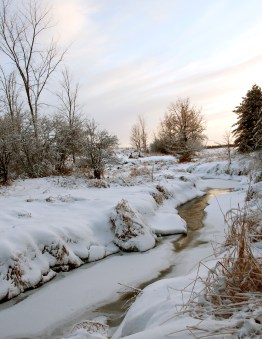
winterBefore leaving the house, check your batteries are charged, you have a backpack with you to protect your camera gear, are wearing warm boots and gloves with removable fingers that give you control, while keeping your hands warm.

Baby It’s Cold Outside.

The first thing to consider in the temperature.  Sure you’re all bundled up, but what about your camera?  The batteries in your digital camera do not read well in cold, it reduces their output.  Keep your camera warm by carrying it under your coat, as close to your body’s warmth as possible, and carry extra batteries in a warm place too.  Rotate the batteries to give them a chance to warm up again. NASA recommends Lithium and Nickel metal Hybrid batteries as they operate best in cold.  Compact flash cards function well down to – 20C.  Putting a heat pack inside your gloves helps keep hands warm as does wrapping pipe insulation around the legs of your tripod.

Don’t Be Snow Blind.

Once you get past dealing with the cold, taking winter photographs is a piece of cake.  Right?  Nope, you’ve got all that shiny white stuff to deal with.  If you just “meter the scene”, your camera’s built-in light meter will read all that snow as an 18% grey tone.  The snow will look grey and everything else in the picture darker than the snow will look black.  A general rule of thumb is to compensate for the brightness by opening up one or two stops or overexposing to let in more light.  If your camera has exposure compensation you could try that also. Check your monitor to see what works for you.  NOTE: After checking various photographer’s preferences, this guide can range from increasing 1/3 stop to 2 full stops.

Of course if you are trying to photograph the people in that snow scene and use the above method, you run the risk of overexposing them as well. You’ve got to choose which is the most important part of the subject, the people or the snow.  If it’s people you’re after, then the trick is to get right in their face and take a reading off the light that’s hitting it.  Set your camera accordingly and no matter where you shoot from, you should have the proper exposure. If you can’t get an up close reading,for example, someone zooming by on skis, then take a reading off your hand.

Timing is Everything.

Good lighting is the key and the best time is often early morning or late afternoon That’s especially true in snow.  At a low angle, the sun casts long shadows and adds contrast to your subject that otherwise might not be there.  Keep the sun at a right angle to your shot early or late in the day,and behind you when it’s high in the sky.

While the idea of capturing the pristine field of snow might sound appealing, it might lead to a boring photo.  Look for objects that add colour and contrast to your scene.  Colourful ski clothes and dark  contrasty shadows abound in winter.

Because of the glare it is often difficult to see the image in your LCD display. Attaching a hood to shade the scene helps or fashioning one out of duct tape can also work in a pinch.

The biggest risk to operating your camera equipment in winter is condensation that forms when you bring cold camera or lens into a warm moist room.  If you then take the camera back into the cold the condensed water can freeze. preventing your camera from operating or worse (it can cause permanent damage).  To reduce the possibility of condensation, place your camera equipment into a plastic bag, push out most of the air and seal the bag before bringing in into a warm room.   Let the camera gear acclimate to room temperature slowly over several hours before opening the bag.  NOTE: Another photographer pops out the memory card and puts a clean white towel over everything, as all the condensation will form on the towel, and leaves the camera gear to return to room temperature.   When he is in and out of his vehicle he keeps the towel on the gear when it is out of the bag, in the vehicle.

Winter is a time when shape and tone in a landscape is often exaggerated and this can make for some graphic looking photos. In winter, nature provides us with a gift of hoar frost which can cover fences, grass and trees in ice crystals.  Other places to look for ice formations are around the edge of creeks, waterfalls, ponds and lakes.

Marg Jackman

Night Photography Critique

Amy Lo pointed out another free live broadcast on Creativelive titled “Night Photography Critique”. It will be given by Matt Hill on Tuesday October 25th. Details can be found here.

Please let us know by email if you “attend” this course and if you’d like to be advised of future courses.

Marg’s Tip for October

Tips To Help Build Confidence In Photography

confidence-1In the short run you may have really blown a photo shoot, or missed the animal of your dreams because you were not being conscious about your settings, or you were simply absent minded.  The best of the best all fail, but what keeps them on top of their game is the arduous task of owning up to being human and going out to find a solution to your goof.
By the book you may know everything there is to know about exposure triangle, rule of thirds, colour theory etc., but when you are actually shooting do they do more to help or hinder?
Confidence isn’t always consistent and has it’s slumps.  So when you have an off day or night, remember another day or night is just 12 hours away.
Learn from your Mistakes.  Confidence has a conspiracy with failure.  So take 2 steps forward and 1 step back.  Stay committed.
Be vulnerable, enter a photo contest and don’t expect to win.  Letting your photo hang on a wall, while others look at it, even for a few minutes, is a scary prospect for some. People will love it, like it, dislike it or downright hate it, but that doesn’t mean you are wrong.  It means you have succeeded in making the photography world just a little more interesting..  You also never know who you will inspire.
Learn from others but don’t compare yourself to them. So learn from their perspectives, their tutorials and their stories, but don’t get caught up with who is better.

    • In PORTRAITURE, confidence helps you connect with and calm your subject to bring out their inner spirit.  There is little worse than a nervous model and a nervous photographer.  Even if your not 100% sure of what you are doing, show confidence, take your time and slowly adjust your settings to get things closer to your ideas,  Try and keep from getting frustrated and making large adjustments wildly to your gear.
    • For WILDLIFE photography, confidence lets you trust your gut and get in the right place at the right time.  Luck is important, but perseverance will ultimately lead to success.
    • In TRAVEL photography, confidence helps you see beyond the postcard shot. Confidence allows you to see your journey, not the one that is in the travel books.  It helps you see the subtleties and personalize your travel story, rather than trying to take the photo that everyone else wants you to take.
    • In FINE ART photography, confidence will allow your creative side to flow.  It will allow you to access what is sometimes referred to as “being in the zone”  This zone or flow is your brilliance at its best and confidence supports your ambitions as an artist.
    • In BAD WEATHER, confidence helps you see the silver lining.  For all types of photography we rely on light.  A great source of light is outdoors and when that golden hour turns to wind and rain you have a choice – pack up and go, or think outside the box.  Confidence helps you control your surroundings, even when they are out of control, so you can begin to work within them and use them to your advantage.
    • In TOUGH TIMES, photography gives you the grit to continue. Really, this is what a lot of photography comes down to – do you have the gumption to get up early for sunrise or not?  Can you be satisfied with the gear you have and not think about the next lens you want to get?  Can you be the best photographer you can be?  Confidence is hard to gain and can take years to attain.  It is a process and is easier for some than others.  But if you work at it, it will build.  Just as you work on other aspects of your photography, your emotions need work to.

If you start to learn from your mistakes and begin to hang photos on the wall – then guess what?  Your confidence will begin to grow, you will  have more control over photography.  As your confidence grows,it builds and build on itself.
Marg Jackman

Shoot Some Fireworks

16458834683_23c3ddf003_o
Firework 2 by Amy Lo September 2012

At the September meeting, Anne Jones mentioned that there will be an opportunity to shoot fireworks in Kanata as part of the Lumiere Charity Gala to be held on Thursday, September 22nd. The event will be held at Kanata’s Brookstreet Hotel located here.

She suggested shooting from this possible location.

The web site doesn’t specify when the fireworks will start but sunset on the 22nd is at 6:59 pm and twilight is at 7:29/8:03/8:39 (civil/nautical/astronomical).

Please note that the Club’s Carp Fair shootout is also scheduled the same evening.

Marg’s Tip for September

Using Natural Framing to Improve Your Composition

Framing_.3._

To help you compose more exciting and beautiful photographs there are certain key techniques that you can use. Using framing can create extremely impressive and elegant images when done right. Here are some tips.

Natural framing is when you use an element within your image to frame the subject. This draws the eye into the photo and highlights the actual subject. The internal frame can be constructed using a multitude of things you’ll find anywhere – branches, archways, tunnels. door frames etc. as well as things that aren’t solid like light, shadows, rain, fog etc. – it doesn’t matter what you use. Framing is a technique to use sparingly.
Why should you use natural framing?

  • it easily draws your viewer’s eye into the photo and emphasizes the subject.
  • it brings a sense of order and structure to a photo and the eye loves order.
  • to obscure boring sky.
  • to add depth to an image – especially when the item acting as a frame is not in focus.
  • to bring contrasting elements into the photo without detracting from the subject.
  • to create structure.
  • to create a feeling of a self-contained image, particularly if you are photographing something quite ordinary and simple, a frame will help give depth to the subject.

Natural framing is one of the hardest rules to pull off well. Many people use it to make a boring landscape or scene more interesting. If your subject is boring, no technique is going to liven it up. Framing should be used as an additional interesting element – not as an overlay to a mundane scene.

  • a photo looks more natural and pleasing for the frame to take up 2 or 3 sides of the frame.
  • when the frame is out of focus it creates a sense of depth in the image.
  • the frame can be made from different elements – the colours can be the same and have interesting shapes.

Natural framing is a very good way to remember that you are in control of how the viewer’s eye will go around the image. Your job as photographer is to direct the eye.
As a photographer you need to make sure that everything you put in a frame is saying something that you want it to – that the elements are all working together to form the idea and feeling that you seek.

  • what am I feeling here?
  • what is interesting to me in the scene?
  • why is this important?

A final thought from Henri Cartier-Brisson
“You just have to live and life will give you a picture”.

Becoming a Travel Photographer

Amy Lo has pointed out another free course on the Creative Live web site titled Becoming a Travel Photographer. While it seems to be aimed at commercial photographers, it does sound interesting and we all love to travel.

Here’s their description of the course:

Get Paid To Travel By Capturing And Telling Unique Stories

The world is full of unique and beautiful places. By learning the business behind travel photography and mastering how to capture and write those stories, you can get paid while filling up your passport; more importantly, you can brand yourself as a travel photographer.

Laura Grier is a photojournalist who has made a life out of exploring the world, capturing, and writing about her experiences. She has worked for National Geographic, Huffington Post, and is the owner of Beautiful Day Photography (one of LA’s most highly regarded destination wedding companies). In this class she’ll teach you:

  • How to break into the travel photography world
  • How to pitch story ideas and get trips funded
  • How to prepare for destination and travel shoots

It will air for free July 28th and 29th. After that, it will cost $99US

Free Beginning Photographer Course

Creative live is running a free online course for beginning photographers starting Monday July 11th and ending Friday July 15. You’ll learn:

  • How exposure works and how each setting creates a different effect
  • The basics of different shooting modes (Auto, Program, Shutter/Aperture Priority, Manual, etc.)
  • How to make use of your camera’s functions – flash, white balance, exposure compensation, timer, and focus points.
  • How image size and resolution work, and why it matters (or doesn’t)
  • How to choose and use different lenses.
  • The best resources to download, backup, and share your images

Thanks to Amy Lo for sharing this with us.


Fundamentals of Photography Course

July 4-6, Creative Live is presenting “Fundamentals of Photography“, a free online course given by John Greengo. Quoting from their web site:

Build A Strong Foundation For Your Photography Practice.

As a photographer, you will need to master the technical basics of the camera and form an understanding of the kind of equipment you need. The Fundamentals of Digital Photography will also teach something even more important (and crucial for success) than the mechanics of digital photography – how to bring your creative vision to fruition.

Taught by seasoned photographer John Greengo, the Fundamentals of Digital Photography places emphasis on quality visuals and experiential learning. In this course, you’ll learn:
  • How to bring together the elements of manual mode to create an evocative image: shutter speed, aperture, and image composition 
  • How to choose the right gear, and develop efficient workflow 
  • How to recognize and take advantage of beautiful natural light 

John will teach you to step back from your images and think critically about your motivations, process, and ultimate goals for a digital photography project. You’ll learn to analyze your vision and identify areas for growth. John will also explore the difference between the world seen by the human eye and the world seen by the camera sensor. By forming an awareness of the gap between the two, you will be able to use your equipment to its greatest potential.

Amy Lo and Anne Jones are both big fans of the Creative Live courses. Amy says:
“Anne Jones introduced me to this workshop several years ago and since then I have been attending it every year, and I always learned something new.”
Reserve your place here.