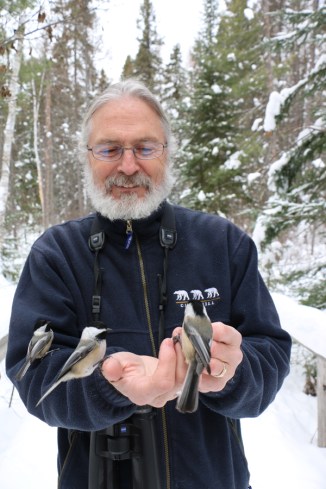
Director, National Capital Sand Dune Conservation Project
Founder of the internationally renowned quarterly scientific journal “Biodiversity”
Research Scientist (Entomologist), specializing in Microlepidoptera specifically the leafrollers, budworms and budmoths, mosquitoes and other biting flies, and ladybird beetles
Former scientific staff of the Canadian Forest Service, Natural Resources Canada and Agriculture and Agri-Food Canada (AAFC)
Former Chair of the Curatorial Committee for the Canadian National Collection of Insects, Arachnids and Nematodes (AAFC)
We hope you all had a great summer and really enjoyed all the Canada 150 activities and other opportunities to take lots of photos.
Join us for our next Camera Club meeting which with be held on Friday, September 1st at 9:15 AM.
Our meeting will include:
Slide show of Member Images from the Canada 150th Assignment
Phil’s Tip of the Day on Lens Filters
Presentation on Insect Photography by Dr. Dang
Review of Chosen Photos
Announcements and Closing Remarks
The Mentors will be available before the meeting to help you with any technical or creative questions you have about photography.
Your images for the assignment must be emailed by noon on Friday, August 25th to be included in the slide show. For details on how to submit photos including formats and titles go to our Galleries page.
Henry’s is putting on a two-session course that challenges students to think outside of the class room and put all their knowledge to use in this travel/street photography based event. Three hours of dedicated shooting will be followed later with a 3-hour session to edit, review, and print photos. People can bring their own laptops, or Henry’s can provide computers with the software. As of Thursday August 17th there are only seven of the twelve seats remaining so, if you’re interested, act fast! The $150 fee covers both sessions.
Contact Henry’s 613-836-1016 or by email for more details and to enroll.
Techniques to shoot water (use of ND filters, flash)
Long exposures
Choosing the right lens/creative techniques when limited to one focal length
Dealing with shadows and harsh light (Flash photography, bending natural light with reflectors
Course Outline, Editing:
Simplifying composition
Converting to black and white
HDR
Smoothing blemishes, removing distracting elements
Stitching panoramas
Stitching focus stacked and/or bracketed images
Lightroom organization
Colour correction
Optimizing for printing
All students leave with one 13×19 print of a photo taken and edited on this course
Who should attend:
Individuals who would like to take their photography to the next level with the guidance of several instructors while learning how to not only think and shoot creatively, but also learn how to optimize their work flow and editing habits.
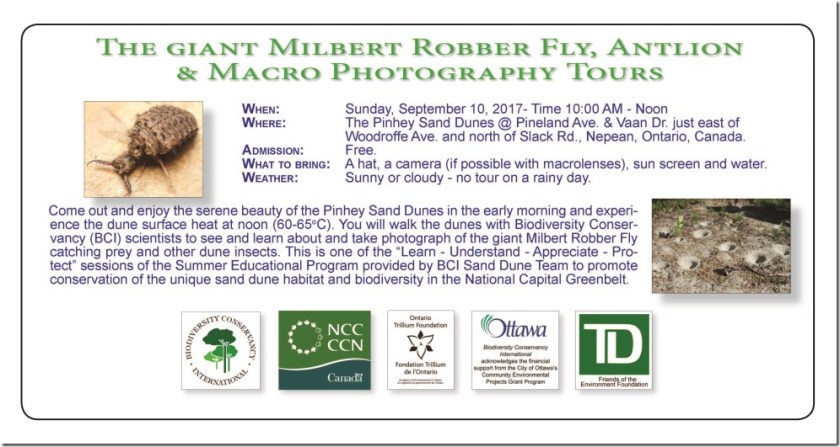
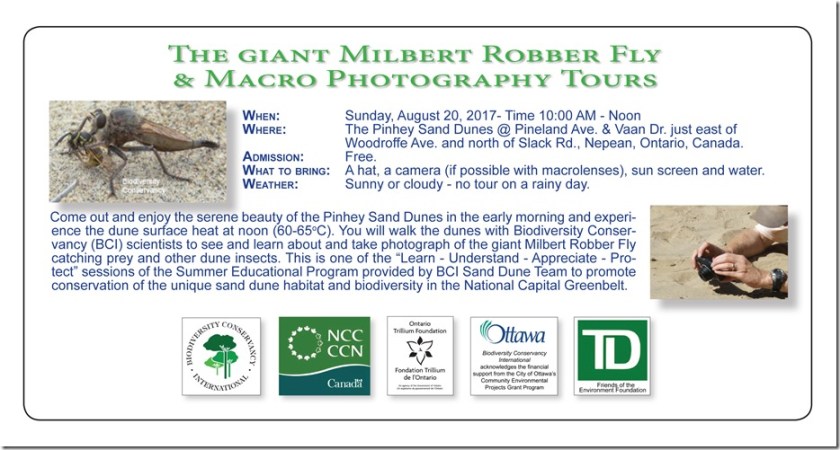
In case you missed the last insect macro photography event at Pinhey Sand Dunes there is another guided tour this Sunday. For location details see the previous post.
If you missed the July 16th event at Pinhey Dunes and would like a chance to take some spectacular macro images like Amy Lo shot, here is a list of the remaining 2017 public tours of the Pinhey Sand Dunes put on by Biodiversity Conservancy International:
August 06
Sand Wasps & Macro Photography Watch the super sand diggers
August 20
Giant Robber Fly & Macro Photography Observe the 4-5 cm voracious hunters catching prey in flight
September 03
Antlions, Doodle Bugs & Macro Photography Observe sand swimmers leaving wiggly trails, building pitfall traps and capturing prey
September 10
Antlions and Giant Robber Fly & Macro Photography Last glimpse of 2017 dune biodiversity
October (date to be determined)
Ottawa-Gatineau Geo-Heritage Pinhey Sand Dunes System is one of Ottawa Gatineau Geoheritage sites
November 05
Dune Walk (6 km) & Season End Dune Maintenance Meet the Pinhey Dunes Watch Group at work
Amy Lo and Marg Jackman went on the guided tour and came back with some great pictures of Ghost Tiger Beetles and Dune Spiders
Amy said:
It was quite an experience to shoot these critters. First we could hardly see them unless they were pointed out to us by the entomologist, second you had to approach them with caution. We were on our knees most of the time as we couldn’t let the critters see our shadow.
Launched in 1991, the Kodak DCS 100 digital camera cost as much as US $13 000 and required a 5-kilogram external data storage unit that users had to carry on a shoulder strap. The sight of a person lugging the contraption? Not a Kodak moment. Still, the camera’s electronics—housed inside a Nikon F3 body—included one impressive piece of hardware: a thumbnail-size chip that could capture images at a resolution of 1.3 megapixels, enough for sharp 5-by-7-inch prints. “At the time, 1 megapixel was a magic number,” says Eric Stevens, the chip’s lead designer, who still works for Kodak. The chip—a true two-phase charge-coupled device—became the basis for future CCD sensors, helping to kick-start the digital photography revolution. What, by the way, was the very first photo made with the KAF-1300? “Uh,” says Stevens, “we just pointed the sensor at the wall of the laboratory.”
Club member and AV coordinator Stu Moxley came up with MosaïCanada as an interesting subject for our summer project: Canada 150. Here’s an article from the Ottawa Citizen describing it.