
 At the April 7th meeting Ron Pearce gave us an excellent presentation on how to enhance an image by creating a composite with textures. His images are available here.
Author: ksccc
iPhone Photography
Click here to see Anne Jones’ notes on iPhone Photography from the April 7th meeting.
Anne also mentioned PhotoSync for moving photos between her Apple devices.
Marg’s Tip for April
Figure Out What Type of Photographer You Are

You should try shooting all sorts of stuff – from food to landscapes, from portraits to sports, from products to travel, and everything in between. When you are just starting out, shoot everything. And once you have done that, sit down and figure out what kind of photographer you really want to be and work on that.
The first step is to take a good look at the stuff you’ve been shooting and ask yourself, “Which one of these do I seen to have knack for? Or, Which shots have people told me I have a knack for? Chances are there is something you shot that you particularly felt you had a knack for – you just kind of knew what to do.
Okay, that’s step one (and it might be more than one thing – you might feel like you have a knack for travel, sports and natural light portraits, and that’s okay). The next step is to ask yourself, “Which one of these do I really enjoy shooting?” This is really important, because this is what you should be focusing on. There’s no sense at getting really good at product photography when what you really want to be is a natural light portrait photographer.
But, few photographers, even more experienced ones, really sit down and think this through – they just shoot what comes their way. And while they may wind up being competent at shooting a lot of different things, I’m guessing being competent isn’t your goal (it’s like getting a C+ in class). Finding who you are as a photographer allows you to focus your learning, your energy, and your time in the right direction. When you start to get good at what you really enjoy, this is when the magic happens.
Marg Jackman
Orchidophelia
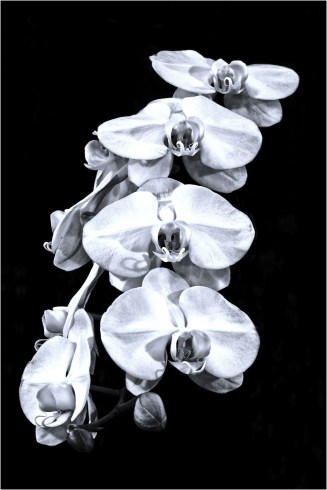
For a chance to shoot some spectacular flowers, visit the orchid show which is back at the RA Centre on the weekend of Saturday April 22 from 12:00 to 5:00 and Sunday April 23 from 9:00 to 5:00.
For more details check out their website. They encourage photography but limit the use of tripods to Sunday the 23rd from 9:00 to 11:00
To see a few examples of images shot by club members at a past show look at our May 2014 gallery.
April Meeting
The next Camera Club meeting with be held on Friday April 7th at 9:15 AM.
Our meeting will include:
- Three member presentations
- iPhone Photography by Anne
- Composite Photography by Ron
- Group of 4’s, 52 Week Challenge by Fraser
- Announcements on the Canadian Camera Conference 2017 and the Kanata Cultural Festival
- Marg’s photography hint and joke
- Slide show of member images from March “Fixed in Post” assignment. Members may submit one original unedited photo (straight from the camera) and the same photo edited. See below for additional information on submitting images.
- Slide show and suggestions for member’s unedited photos. For members who are not comfortable with a photo editing program, they may submit one unedited photo for review. See below for additional information on submitting photos.
- Tip of the Day “Depth of Field” by Phil
- Announcements
Your images from the March “Fixed in Post” assignment include either:
- Two photos; one unedited and one edited. In Photo 1 include the word “original” in the filename e.g. Snowy beach original by John Williamson.jpg. In Photo 2 include the word “edited” in the filename e.g. Snowy beach edited by John Williamson.jpg; OR
- One unedited photo for members to provide suggestions on how it could be edited e.g. Snowy beach by John Williamson.jpg
Your images for the March assignment must be emailed by noon on Friday, March 31st to be included in the slide show. For details on how to submit photos including formats and titles (see above for title changes to the filename for this assignment) go to our Galleries page.
The Mentors will be available before the meeting to help you with any technical or creative questions you have about photography.
See you on April 7th.
World Backup Day!
 Did you know that Friday March 31st is World Backup Day?
If your computer or smartphone failed tomorrow or it was infected with ransomware, all the files it contains could be lost! Would you lose all your precious photographs?
Do you have a backup plan in place?
If you need help with setting up a backup procedure why not book an hour with one of the Seniors Council’s computer tutors? They can help you set up a safe, thorough and automatic backup procedure for all your files.
Aperture Paradox
Question: If “fast” lenses are better, why are so many images taken in the “normal” aperture range?
Answer: The big advantage of “fast” lenses ( and the reason they are called fast), is that they have wide maximum apertures, and so make faster shutter speeds available in low light, without having to bump up your ISO too far. Another advantage is that wider apertures enable a tighter depth of field, and this is often used to blur the background (or foreground) in portraiture and still life photography. Even so, for general shots, you’ll typically use an aperture of around F/8. This is usually the “sweet spot” of a lens, at which it delivers optimum image quality. Similarly, in many situations you may not want to minimize depth of field – when you want to get both eyes sharp in a portrait of someone sitting three-quarters on, for example.
Marg Jackman
Critique of Photographs

General Guidelines
It is hard for a photographer not to be sensitive to remarks about changes and possible improvements to ones’ photographs. Remember the comments are on the photographs not the photographer. Some of the comments will carry with them the bias of the reviewer. As an example a world class female reviewer once told me about this problem by saying: “I hate snakes, so it is real hard for me to give a good review on a snake, no matter how good and wonderful the photograph may be.”
Also there are no definite rules of what makes a bad or great photo which have come to us from Mount Sinai. Even generally accepted rules, such as the “Rule of Thirds” can be successfully broken. For those who do post processing remember there is never a photograph taken that cannot be improved in some way – including how it is framed. Now on with some basics of doing a critique.
Basic Critique Considerations
- Is the photo properly focused, with foreground, main subject, and eyes (usually) sharp?
- Is the background appropriate, or is it too busy/cluttered? Does it have best focus or out of focus areas appropriate for image?
- Does the photo display a good depth of field for subject and treatment of subject?
- How is the exposure? Is it too dark (underexposed), too light (over exposed). blown out, blocked up, or okay?
- How is the image contrast? Flat with little tonal difference or too extreme?
- Are the colours accurate or appropriate for subject? Are there overlaps or bleeding, too much saturation or not saturated enough, or other colour issues?
- Is the composition pleasing, properly balanced, and appropriate? Do objects in images give a 3-D effect? Does use of framing, leading lines, image placement, or other composition components, indicate direction or movement, and does this improve the image or distract from it?
- Is cropping required, or is there to little or too much cropping to flatter main subject/topic?
- Is your eye drawn to the best spot/subject of the image first, and does your view stay within the main subject/topic of picture or are there bright, dark, or highly colourful distractions?
- Is it easy to determine what the best spot or subject is?
- Is there a clear story line or message in the photo?
- Is there a uniqueness or rarity to captured scene or captured item?
- Does the photo carry emotional appeal, such as babies/moms, puppies, love, danger, and so on?
- Are there any technical issues which distract from the image quality or appeal?
One of the best ways for a photographer to improve is by having their work critiqued. Even though one may not agree with critique points made, the process helps one identify what appeals to the viewers and what does not. With this understanding you are better able to create the best photograph you or a viewer likes. The more you practice and apply your knowledge the better photographer you will become.
Based on this post by Scott Bourne in the Photofocus blog.
Frank Knor
Mud Lake Shootout
The club will be holding a shoot-out at Mud Lake this spring.


- May 12th (rain date May 19th) at 08:30
- Lead by Anne Jones and Phil Tughan
- More details at April 7th and May 5th meetings, in the blog and by email.
- Shooting assignment for May changed to “Nature”
- Parking along Cassels Street adjacent to Mud lake just west of filtration plant.
- Club members who are experienced nature photographers will be wearing their name badges and will be glad to help out members with tips on how to get the best images they can.
For more information on Mud Lake, check out the NCC web site.
Photograph Havana with David Barbour

Ottawa Photographer David Barbour is leading a photo tour to Havana May 27-June 3.
Explore Havana with David, improve your skills as a creative photographer and be introduced to one of the most fascinating cities in the world. The one-week workshop will balance specific photo assignments with evening critiques and presentations. Each day, students will travel to various locations in the city and concentrate on photographing people and the architecture of the city. Side trips to the East Beaches and a day trip to Regla will complete the week. More details here.
Register at School of the Photographic Arts: Ottawa.
David also teaches at the Ottawa School of Art:
- Intro to Digital April 18- May 11 9 classes
- Intro to Film April 8-20th 6 classes
To see examples of David’s work, visit his website.

